viernes, 12 de abril de 2013

Aegean Art!


The first samples of art found around the Mediterranean Sea before being populated by Greeks are white stone figurines represent goddesses (famous statuette of a priestess of the snake) and some male characters, standing or seated, with limited visibility and highly stylized strokes. Small idols are probably related to cults of which we know nothing. These figurines have been found in the Cyclades, and the oldest dating back to the mid-third millennium BC It is the stage known as Middle Helladic art.

In architecture was used stone, adobe and brick, plaster-like high quality alabaster sustainable element was used as the pillar of square base and column Aegean (forerunner of the Greek Doric column), circular base and stem smooth thicker at the top than at the bottom or Knossos Palace Knossos palace Crete characteristic, so aberíntica built on terraces on top of hills, with a central courtyard 60 meters long by 29 wide, here is a sample of painting, paint a mural very naturalistic and realistic, not merely reproduce typified positions, but seeks the expression of movement as cool Bullfighting.

There are very few specimens of sculpture, but found small ceramic statues, gold or ivory, such as Goddesses or Priestesses of Serpents. v-representations is a goddess probably of fertility or of a priestess , the figures are the characteristic suit, tight bodice with short sleeves to the elbow, and low-cut that leaves the chest bare and ruffled skirt, the hit may have different forms: a turban, as
tiara, etc., and may be horned animal with a religious sense, the arms are separated from the body, in prayer, creating a good space and
making the figure lose rigidity.

Islamic Art!


The Islamic era, Hegira, begins in 622, when Muhammad march from Mecca to Medina to escape the intransigence shown by his preaching. From that date, together with religious faith, emerged a new social and political attitudes, in less than a century, expanded from the Bay of Bengal to the Atlantic Ocean.

Islam is based on a holy book, the Qoran, which contains the word of Allah that in this case is their God revealed to Muhammad or sent his messenger. The communication of the divine message was conducted in Arabic which went on to become the official language and the vehicle unit.
Islamic art is known by the artistic style developed in the culture generated by the Islamic religion.

Islamic art has a certain stylistic unity, due to the displacement of artists, dealers, patrons and workers. The use of a common script throughout the Islamic world and the development of calligraphy reinforce this idea of ​​unity. Attached great importance to the geometry and decoration that could be of three types:

     Kufic Calligraphy: using verses from the Koran.
     Lacería: using interlaced lines or polygons forming stars.
     Ataurique: using plant designs.

In architecture, buildings created with specific functions such as mosques and madrassas, following the same basic pattern, but with different shapes. Virtually no art of sculpture but the achievements of any metal, ivory or ceramic, often reaching high technical perfection. There is also a painting and book illumination in the sacred and profane.


Egyptian Art!


Egyptian art is unquestionably the art form that has captivated modern man. Hieroglyphs were a writing system invented by the ancient Egyptians. It was used from the predynastic until the fourth century. The ancient Egyptians used three basic types of writing: hieroglyphic, hieratic and demotic, the latter corresponds to the Late Period of Egypt.

Egyptian civilization not only created an architecture, sculpture and painting of breathtaking beauty, but also a culture that has made dream researchers, writers and ordinary people, where it melts the historical, the mythical and mysterious.
 

Egyptian art is an art that is closely related to the environment in which it operates. This media influences different aspects: firstly the geographical environment determines a closed culture that makes an art impervious to outside influences, it will evolve just as they will do will be on their own ways due to lack of communication with the outside.

On the other hand, the medium will determine some materials that indicate a disregard for earthly life and a desire to perpetuate the moral and the god of the dead, so that art is often a function of temples and tombs. This relates to both art determinants also are given by the media: the monarchy and religion.                                
 
Thus, Pharaoh and nobles from that time and priests will be the main customers. This is an official and courtly art, developed under the religion mainly because it is linked Pharaoh. It is therefore not an autonomous art.

Egyptian art is always subject to rules, so it is very similar and monotonous, so homogeneous. It's a stereotypical art is valued at more accuracy than the original finish. They also have a symbolic nature and magic.


Greek Art!


Greek art sets a benchmark for Western civilization endure to this day. The ancient Greek models are regarded as classics and canons sculptural and architectural styles have been recreated over and over again throughout the history of the West. To speak of Greek painting is necessary to refer to ceramics, since precisely in decorating vases, plates and bowls, whose marketing was a very productive business in ancient Greece, where he was able to develop this art.

Early designs were elementary geometric forms-hence the name of the geometric receive this first period (ninth and eighth centuries BC.) - That just stood out above the surface.
 SCULPTURES:
The first Greek sculptures were taking place in the ninth century BC. Firstly sculptures were small human figures made ​​very malleable materials such as clay, ivory or wax. It was not until the Archaic period on the seventh and sixth centuries BC. There was where Greeks began to work the stone. The most common of the early works were simple statues of boys named kouros and girls who were Kores. Smooth, rounded shapes, these figures in stone plasmaban a beauty ideal.

These figures bore a strong resemblance to the Egyptian sculptures that served as a model. With the arrival of classicism V and IV centuries BC., Greek statuary was taking a character and finally abandoned the primitive oriental patterns. By studying the ratios could copy faithfully the human anatomy and faces definitely gained in expressiveness and realism.

Greek painting:
The last major school of Greek pottery painting was red-figure, in which the black-figure technique was reversed: orange silhouettes were formed by painting around them in black, allowing interior details to be painted rather than incised. This gave the artist much more control in drawing smooth curves or varying the thickness of lines when adding details. It also allowed for gradients of colour, since the black paint could be diluted to acquire shades of brown.


Indian Art.

-->

The art of India is mainly characterized as a reflection of the complex Indian society, multiethnic and multicultural. Also has a primarily religious character, serving art as a means of transmission of the various religions that have marked India: Hinduism, Buddhism, Islam, Christianity, etc.. I personally noticed as a feature of Indian art that it drive towards integration with nature, as an adaptation to the universal order, considering that most of natural elements (mountains, rivers, trees) have for the Indians a sacred character tha same as the cow that is also sacred for them.
It is characterized by the distinctive styling of their figures.
 
Features:
Indian Drawing seems to be very sensual and sensitive.
Decorativism in clothes, landscapes, objects, various ornaments, etc.
colorism harmonious and pleasant which gives beauty.
The line as a key element in the compositions. The contours give it personality and style generate much visual linking the whole game.
Thematically are representations of their gods and their stories or legends.
• Animals are present in many works: Birds, elephants (as you can see on the image), fish and many others more.
Notable and erotic themes of love between the gods and their loved ones.
India has been the cradle of a great civilization that spread, thanks largely to the spread of Buddhism throughout central and southeast Asia, reaching influence even powerful cultures like China and Japan. In West was known mainly after expedition to India by Alexander the Great, when news arrived of technical advances, cultural and art developed in the Indian subcontinent.


domingo, 31 de marzo de 2013

Greco Roman Temples and Buildings..!

-->

“Debod Temple”

-->
    The Temple of Debod is an Greco Roman building complex currently located in Madrid, it is located at the west of the Plaza of Spain, next to the Paseo del Pintor Rosales, a high where was the headquarters of the Mountain.Debod Temple was a gift from Egypt to Spain (1968), in return for Spanish assistance, following the international call made by UNESCO to save the temples of Nubia, Abu Simbel primarily, endangered because the construction of the Aswan Dam.


-->
“Edfu Temple”

-->
-->
    The Edfu Temple is an ancient Egyptian temple located on the west bank of the Nile in the city of Edfu during the Greco-Roman period became known as Magna Apolinópolis, dedicated to the god of gods, Horus-Apolo.1 is the second temple largest in Egypt after Karnak and one of the best preserved. The temple, dedicated to the falcon god Horus, was built during the Hellenistic period between 237 and 57. C.


-->
Santa María Del Fiore De Florencia

-->
 
-->
    The Basilica of Santa Maria del Fiore is the cathedral duomo in Italian, from the Latin that means Domus Dei, God's House of the Roman Catholic Archdiocese of Florence, noted for its dome. It is one of the masterpieces of Gothic and early Renaissance Italian. Symbol of wealth and power in the Tuscan capital during the thirteenth and fourteenth century, the Florentine cathedral is one of the largest buildings in Christendom.

-->
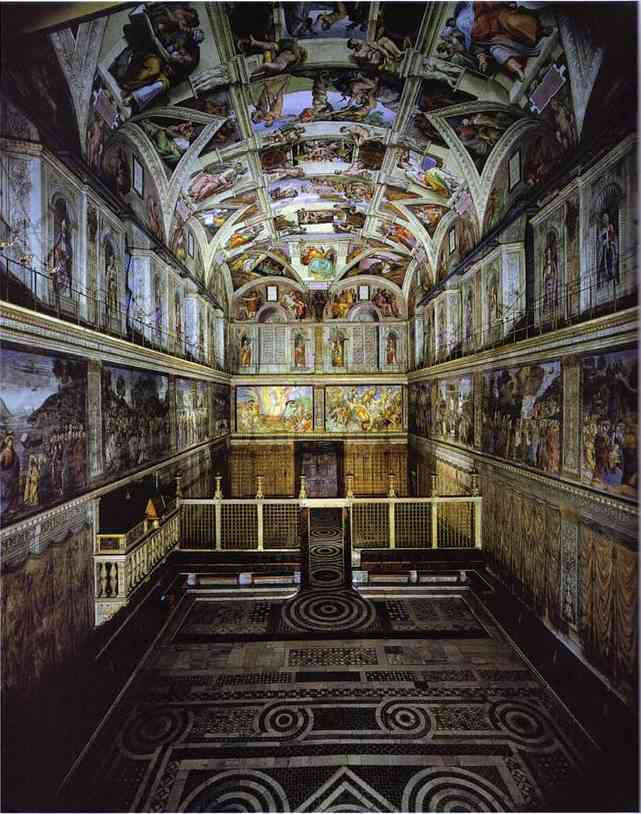
Sistine Chapel”

-->
    The Sistine Chapel is the most famous chapel of the Apostolic Palace of the Vatican, the official residence of the Pope. It is located to the right of the Basilica of St. Peter and originally served as Vatican Fort Hood. It is famous for its architecture, evocative of Solomon's Temple of the Old Testament, and its decoration in fresco work of the greatest Renaissance artists including Michelangelo, Raphael and Botticelli. By order of Pope Julius II, Michelangelo decorated the dome between 1508 and 1512.

-->
“Sainte-Chapelle De París”


  -->
    The Holy Chapel (Sainte-Chapelle in French), also called the royal chapel of the Île de la Cité, is a Gothic church located in downtown of  Paris, France. It is considered one of the masterpieces of radiant period of Gothic architecture. It was built to house relics purchased by King St. Louis of France, so it has been regarded as a huge shrine. The roof, supported by countless columns support the weight of the entire building, the chapel was built low to be useful as functional and architectural full relief allowed the construction of the chapel high and bear the full weight of it.